

-
 For this episode of Island Interviews, KUCB’s Sofia Stuart-Rasi sat down with Allie Brown, the participant coordinator for COASST, to learn what the training involves and how the data is used to document history.
 -
 Kanesia McGlashan-Price/KUCBThe U.S. Army Corps of Engineers said its cleanup work plan for former military sites is shrinking by about 40%, but officials say cleanup sites around Unalaska are still moving forward.


-
 Friday was the Spring Equinox, but the start of the season was nowhere in sight in Unalaska.
 -
 The deal between the National Oceanic and Atmospheric Administration and the University of Alaska Fairbanks took effect on March 1.
 -
 A volcano on Atka Island in the Aleutians has been showing increasing signs of unrest over the past two weeks, and scientists say the uptick in activity is significant enough to warrant a closer watch.
 -
 The western Aleutians have seen higher than average seismic activity since March 2, according to the Alaska Earthquake Center.
 -
 A magnitude 6.1 earthquake struck southwest of Nikolski on the Aleutian chain Sunday night at 8:11 p.m. No tsunami was generated, according to the National Tsunami Warning Center.
 -
 Every February, birders around the world spend a few days tallying every species they can find, giving scientists a snapshot of bird populations just before spring migration begins.
 -
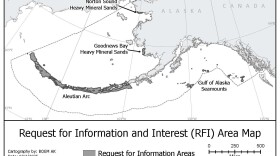 The Bureau of Ocean Energy Management is evaluating whether to hold a first-of-its-kind lease sale for seabed mineral development in federal waters off Alaska, and seeking information and input to help decide if it should move forward.
 -
 For this episode of Island Interviews, KUCB's Kanesia McGlashin-Price spoke with Unalaska naturalist and birder Suzi Golodoff, who spotted the three visiting birds. Golodoff explains why this is such a rare event and how a powerful typhoon may have swept these Asian birds across the Pacific.
 -
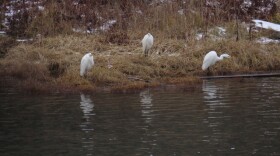 In December, nine Great Egrets turned up in Adak, five in Nikolski, and, for the first time documented, three in Unalaska, according to Unalaska naturalist Suzi Golodoff.
 -
 On December 20, 2025, Unalaska Island held its 33rd annual Christmas Bird Count, participating in the international Audubon Count that’s been held since the year 1900.


