


If you were hiking around Unalaska in July, you may have seen a small group of scientists in the tundra with insect nets in hand. They were looking for bumblebees.
The researchers were in Unalaska as part of the Alaska Bee Atlas, a statewide program that aims to better understand where bees live in Alaska, the habitats they’re associated with and what flowers they visit.
Their work in the Aleutians is part of the Aleutian Bumblebee Project, supported by the U.S. Fish and Wildlife Service.
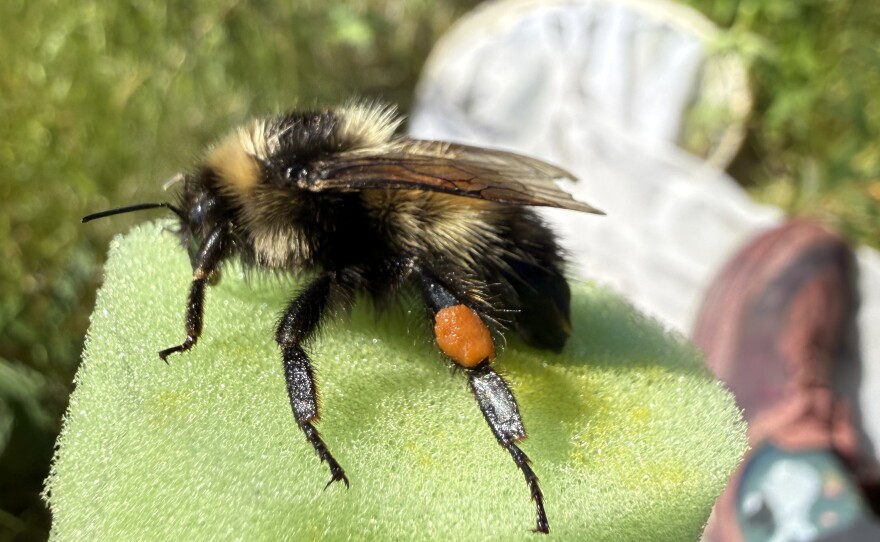
The team was trying to identify which species of bumblebees exist on the island by examining physical characteristics, including stripe patterns, hind-leg pollen baskets and the length of their cheeks.
“We were finding with our data — that the Aleutian system, there's a really large data gap,” said Justin Fulkerson, a lead botanist with the Alaska Center for Conservation Science at the University of Alaska Anchorage. “We only had data on bees for maybe less than 10% of the islands.”
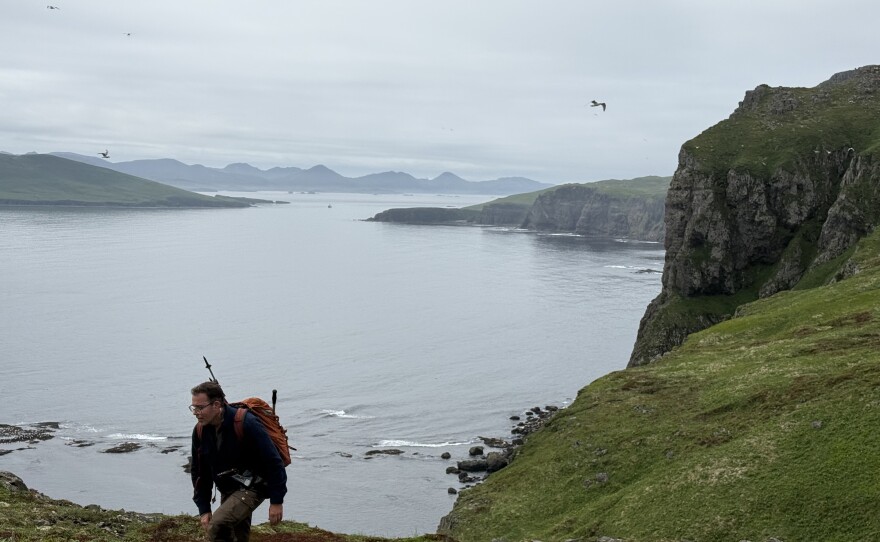
Fulkerson has been visiting the Aleutian Chain for the past couple of years as part of the Alaska Bee Atlas. Last summer, he surveyed bees in Adak. This summer, he collected data in several more locations, including Sand Point, Unalaska and the Near Islands.
Hollis Woodard, a professor of entomology at the University of California, Riverside, is also working on the project. She said successful fieldwork depends on good weather.
“We try to go out on days when there's amazing weather, which we actually got the first two full days we were here,” Woodard said. “So if it's too cold, too rainy, the bumblebees just won't fly.”
When the weather cooperated, the researchers netted bees for a closer look. In just four days on the island, they more than quadrupled the number of bumblebee records for Unalaska.
They also found some surprises.
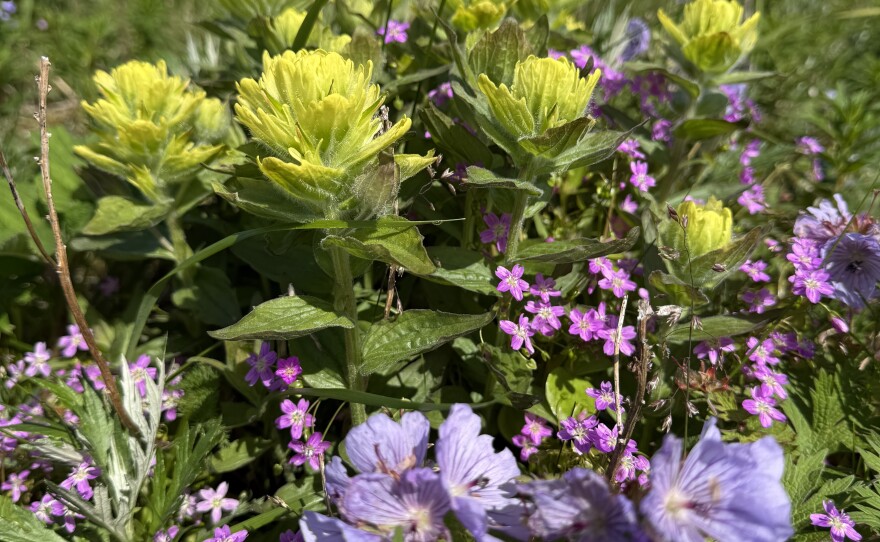
“We're finding that right now, they're just going crazy for geraniums,” Fulkerson said. “And I find that interesting, because over in the mainland I don't really see the bumblebees visiting the geraniums that much. They like to visit the lupins or the pea flowers.”
Historical records dating back to 1897 documented roughly 30 bumblebee observations on Unalaska, most of them from around town. Older records also suggest that around six species of bumblebees lived on the island. But during this summer’s survey, researchers confidently identified only two or three species, including the Forest and McKay’s bumblebees.
The findings raise questions about whether other species are active at different times of the year, or whether some older records need to be revisited.
Woodard said understanding which bee species live on Unalaska is important because bumblebees are major pollinators.
“Bumblebees actually are super important pollinators of blueberry,” Woodard said. “One of the reasons why is that they'll land on the flower and they sonicate it, just like a sonicating toothbrush, and that causes the flower to release some pollen.”
Woodard said this relationship has been studied in other parts of the country, but there’s still a lot to learn about bumblebees and berry pollination in the Aleutians.
Fulkerson said the baseline data could also help researchers track how climate change affects bumblebees.
“With our climate changing, we don't know the degree that it'll affect them in the Aleutians or in Alaska,” Fulkerson said. “But if they are going to be disappearing, we need to know what species are here because if we don't know what's here, we don't know what we're going to lose.”
Both scientists say locals can help with their research. If you see a bumblebee on a flower, researchers encourage you to take a photo and upload it to the free iNaturalist app. The images can be reviewed by scientists and other citizen scientists, helping researchers build a clearer picture of the bumblebees living across the Aleutians.


