

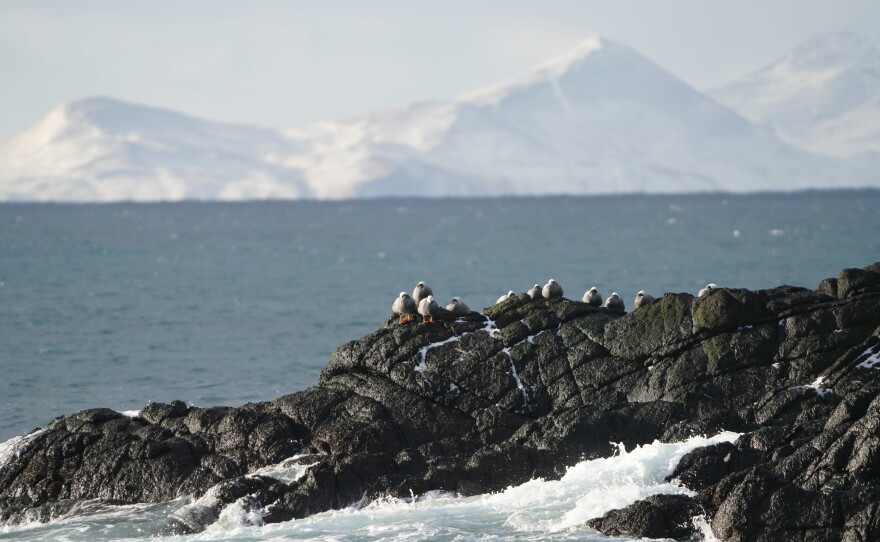
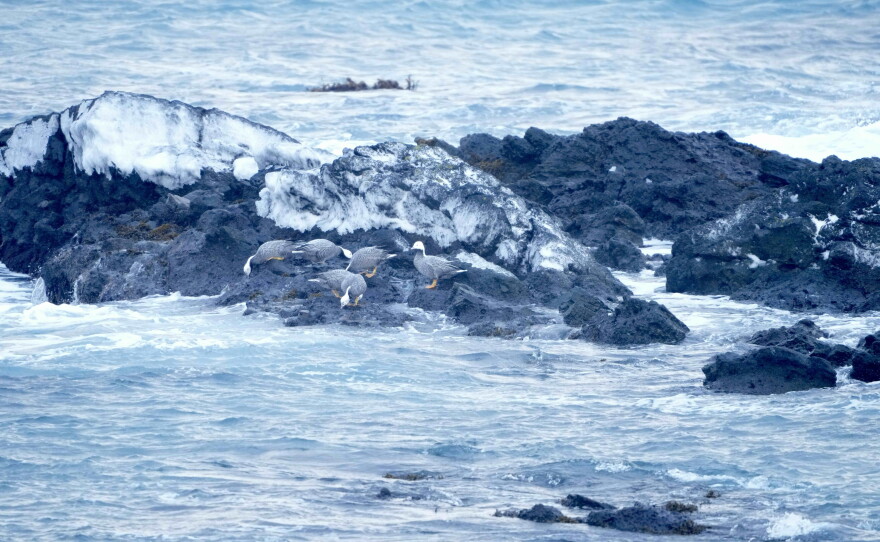
Emperor geese spend the winter scattered across the coastal areas of the Bering Sea, but scientists know relatively little about how the birds live during those winter months.
Their population has declined significantly over time, with subsistence hunting closed for much of the past four decades. Researchers are working to better understand what may be contributing to that decline.
Unlike many other waterfowl, emperor geese don't migrate south for the winter.
They spend their entire lives around the Bering Sea, from the Yukon-Kuskokwim Delta to Kodiak, along the Alaska Peninsula and across the Aleutian Chain.
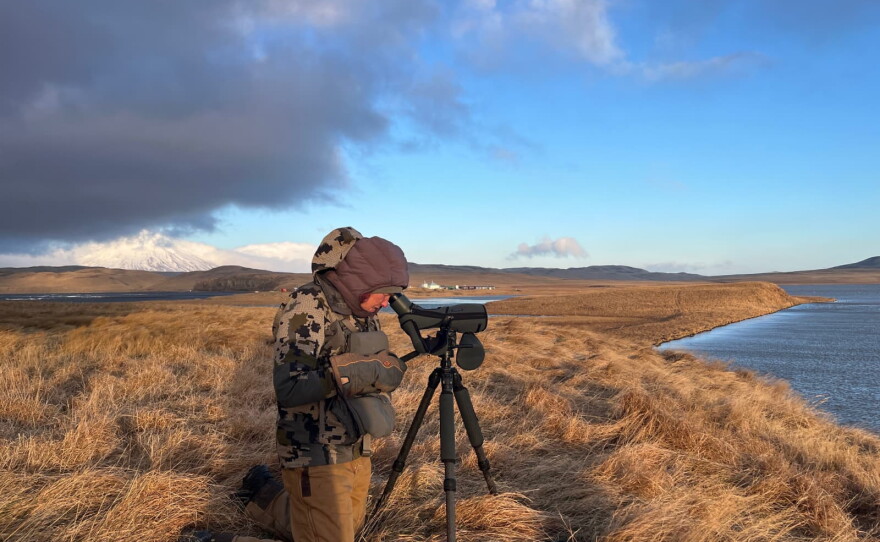
For the past three winters, wildlife biologist Robyn Thomas has been studying emperor geese in two locations, comparing their demography and diet.
“We were pretty surprised, actually,” Thomas said. “We kind of were thinking maybe these patterns would be somewhat what they ended up being, but we were surprised at like the magnitude of these patterns.”
The work is part of her graduate research at Colorado State University in partnership with the Alaska Department of Fish and Game, which has been collecting data on wintering emperor geese since 2019.
Researchers hope to better understand how the birds live across their wintering grounds, and whether that can offer clues about the species’ declining numbers.
An estimated 140,000 emperor geese lived across Alaska in the 1960s. By the 1980s, that number had fallen to about 42,000.
The population slowly recovered over several decades. Subsistence and sport hunting briefly reopened in 2017, but closed again after another population decline.
Scientists aren’t exactly sure what caused the decline, but suspect multiple factors may be involved.
“Their wintering range spans thousands of miles, and they experience really different things throughout the winter,” Thomas said. “So we chose the easternmost and westernmost kind of edges of their wintering range, or at least the places we could access.”
Those locations were Kodiak and Shemya, at opposite ends of the birds’ wintering range.
Thomas surveyed emperor geese at both locations over three winters. The two vary in habitat, migration distances, and available resources.
Her research examined several aspects of the birds' lives, including reproduction, juvenile survival, and body weight.
Those measures were generally higher on Kodiak than Shemya.
“One out of every three birds or so is a juvenile, and it's noticeable when you're out on Kodiak,” Thomas said. “There’s just too many juveniles to keep track of. But it's a totally different story on Shemya.”
Over the three years of the study, Shemya had closer to one juvenile for every 16 adults.
Thomas describes the Shemya birds as a “stress population,” saying that they might be experiencing greater environmental strains, including their access to food.
The researchers found differences in the birds' diets too.
She said goose droppings on Shemya contained more grasses and seaweeds, while geese on Kodiak ate more barnacles and mussels.
Blood samples supported those findings, showing differences in the birds’ diets through their chemical fingerprint.
“We were able to do this for hundreds of birds, and the Shemya birds were typically eating lower on the food web,” Thomas said. “So that means they're basically just getting less protein.”
Emperor geese also have high site fidelity, meaning they tend to return to the same wintering sites year after year.
Thomas suspects that the Aleutians may have been a more favorable habitat for emperor geese in the past, but the birds may be slow to change their behavior.
More research is needed to understand whether that pattern holds true for the Aleutians.
“That’s one thing we're looking at with this upcoming winter work is just adding more sites to be like, okay, is this a pattern? What's it like in between?” Thomas said. “Because you know our sites are on one end or the other, we're really trying to like fill in what's in the middle.”
This winter, Thomas and another graduate student plan to visit Unalaska, Nikolski, Atka, Cold Bay, Nelson Lagoon, Sandpoint, Chignik Lagoon and Adak.


