

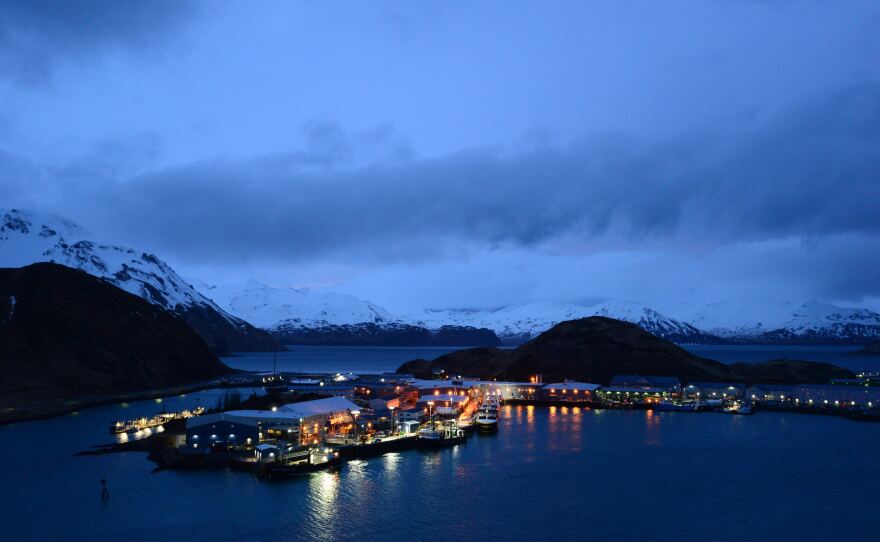

Some of Alaska's largest pollock processors are abandoning a foreign worker visa program that once supplied up to half their workforce, citing rising costs and uncertainty under stricter immigration policies.
Tom Enlow is the president and CEO of UniSea Seafoods, Unalaska’s largest seafood processor. He said the company is moving away from the H-2B visas to save money on an inconsistent system.
“The H-2B program, I think was good for Alaska at a time when we really needed them, you know, during the pandemic, and little bit pre-pandemic, but really it's cost prohibitive to bring workers all the way from Eastern Europe to Alaska,” Enlow said.
The H-2B visa program allows employers to bring foreign workers to the U.S. to fill temporary non-agricultural jobs during shortages. The visas can be difficult to obtain. Companies have to first show they can’t fill the jobs, then they have to apply, and then the U.S. Department of Homeland Security and the U.S. Department of Labor issue the visas through a lottery system.
Enlow said the processing plant moved back to a 100% domestic workforce this summer and will do the same for the upcoming “A” season — a major pollock season that starts later this month and brings thousands of workers to Dutch Harbor.
The main reason for that is cost. He said the Trump administration’s approach to hiring foreign workers has also made a difficult and expensive process even more complicated.
“It doesn't make for good planning for processors, when you are bringing 200 or 300 people in from Eastern Europe and you don't know for sure if you're going to get supplemental visas, if [they’re] going to get approved in time, if they're going to be in Alaska when you need them, when the season’s started,” he said.
UniSea started participating in the H-2B program in 2019, and prior to that, the company employed 100% U.S. domestic workers, according to Enlow. Some of those were green card holders or permanent residents, living in the U.S. — most from the Philippines.
When the company was actively using the special visas, as many as half of UniSea’s workers were foreign.
The company still employs a handful of Ukrainian employees who were hired through a special program designed to help those who were displaced from the Russian invasion, and will continue to work for the processor, Enlow said.
“They're not bound by some of the rules and restrictions of the H-2B program,” he said. “They can stay extended periods of time. They can work full time, year round, they don't have to be necessarily processors. They can work in other jobs, in other areas.”
UniSea isn’t the only regional processor filling jobs with American workers. Trident Seafoods — one of the largest seafood processors in the nation — said it employs almost an exclusively domestic workforce.
A spokesperson for the company said the processor — which has facilities across Alaska, from the Aleutians to Southeast and Bristol Bay — has been moving away from the H-2B program since 2023, in an attempt to strengthen long-term, local employment.
Westward Seafoods, another shore-based processor in Unalaska, would not provide information on employment data.
Alaska: the ‘poster child for foreign labor’
Brian Gannon is the vice president of global partnerships for LaborMex, a Texas-based company that helps connect U.S. businesses with foreign nationals for temporary or seasonal work. He said when it comes to handling and packaging Alaska’s massive seafood exports, especially for cod and pollock, the state has a very small local employment pool to work with.
“For 100 years, people have been coming from somewhere else to process fish in Alaska,” Gannon said.
Processing fish involves long hours, and often tough, repetitive and pungent work. Considering there is an entire area of plants often referred to as the “slimeline,” it can be difficult to fill those jobs.
Gannon, who started his career as a guest worker from Montana at a processing plant in Chignik in 1990, said despite the lackluster appeal of processing work, Alaska has done a good job attracting seasonal workers from afar.
“Alaska is really a poster child for foreign labor, in as much as the oil industry and forestry and mineral extraction and seafood production, etc., in Alaska for 150 years, [has] been built on a small amount of available local labor and a large amount of labor coming from somewhere else,” he said.
The Alaska Department of Labor found that in 2023 the state’s seafood industry employed nearly 22,000 workers, roughly 83% of which were nonresidents of the state. That year, the Alaska pollock industry directly employed over 8,000 workers, according to a report from Northern Economics on the contributions of the state’s pollock industry. Most were workers from the U.S., roughly 31% from Alaska, and about 12% were residents of other countries.
H-2B visa program helps fill employment gaps
Gannon said about 10 years ago, the seafood industry’s domestic workforce started to run dry. The industry’s pool of seasonal workers wasn’t replenishing. And that was especially challenging for cod and pollock processing, which unlike salmon, for example, don’t have peak seasons in the summer. He said salmon can have an advantage because it’s a summer fishery, and people sometimes have that season off. Ultimately, Gannon said companies just couldn’t match the shortfalls.
“And that's where that H-2B visa came in quite handy,” he said.
The H-2B visas weren't really used in Alaska’s seafood industry until about 12 years ago, according to Gannon. Congress currently doles out 66,000 for the entire fiscal year, and Gannon said they can get about 250,000 requests. Congress sometimes approves special increases for those visas.
Within the pollock processing industry, the program has been used among all sectors of processors. However, the catcher-processor fleet — that processes at sea — is required by law to employ 75% American citizens and green card holders. According to officials in the industry, they’ve never made any significant use of the H-2B program.
For a while the visas, while complicated to obtain, worked well. But Gannon said over the past several years a lot has changed in the pollock industry.
Changes in the industry spark a return to domestic labor
“So many things have upended the apple cart, and the pollock processors are not necessarily producing as much,” he said.
Gannon said things like the COVID-19 pandemic, the war in Ukraine, changes in the nation’s political dynamics and competition from China and Russia have made it hard for pollock processors to make ends meet.
Gannon said Alaska seafood companies also likely had trouble matching the prevailing wage requirements for H-2B visa holders, which he said had surpassed Alaska’s minimum wage at one point. He said the Department of Labor sets those wages, and they have to be matched or exceeded for all processors at the plant.
The seafood industry in general has also seen increases in processing costs, wages, energy prices, as well as drops in sale prices for every major species group in 2023, according to the National Oceanic and Atmospheric Administration.
Enlow said UniSea won’t be saving much, if any, money right away by switching back to an American workforce, because he’s expecting a high attrition rate.
“And so you're going to need to hire more and bring up more people than you actually would need over time, because you're going to lose some of those workers,” he said.
But Enlow said that should eventually be offset by avoiding uncertainties around international travel and immigration concerns.


